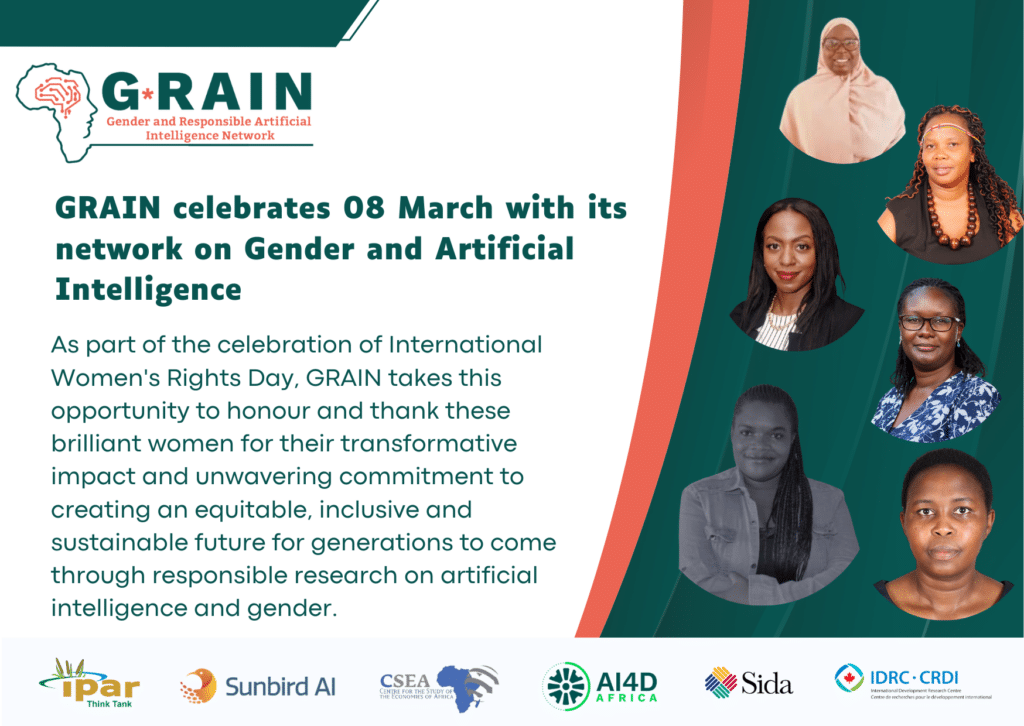
As part of the celebrations for International Women’s Day, GRAIN takes this opportunity to honour and thank these brilliant women for their transformative impact and their unwavering commitment to creating a fair, inclusive and sustainable future for generations to come through responsible research on artificial intelligence and gender. Mutiat Olaitan MOHAMMED from Nigeria, Shamira Ahmed from South Africa, Rebecca Ryakitimbo from the DRC, Dr Joyce Nakatumba-Nabende from Uganda, Angella Ndaka, Chebet Moso and Juliet from Kenya are visionary researchers who are paving the way for a new era of progress and equality by highlighting the crucial importance of gender diversity in the field of artificial intelligence.

Mutiat Olaitan MOHAMMED is leading the project on: ‘AI for Women in Aquaculture’ (AI4WA) in Nigeria
Mutiat is a proactive, results-oriented team player and an advocate for the circular economy and the transformation of waste into wealth. She has a remarkable track record of contributing to and presenting research papers on the recovery of agricultural waste.
Shamira Ahmed leads the research project on : ‘’Responsible AI for gender equality in the circular economy in Africa’’
Shamira is a political entrepreneur, an experienced quantitative economist and an interdisciplinary specialist in policy and research. She has a track record of providing technical assistance to policymakers and regulators in sub-Saharan Africa, notably by co-authoring both confidential and non-confidential policy briefs such as the «African Union Commission Data Policy Framework», amongst others.


Rebecca Ryakitimbo examines the topic of: Mainstreaming gender in AI: a perspective from French- and English-speaking East Africa
She is a technician, a writer, a researcher and a nature lover. Her work has focused on harnessing technological solutions to address community challenges, particularly engagement with digital policy. As co-founder of Digital Grassroots, she worked as part of a project team with the Kondoa community network, using television white space technology to bring internet connectivity to rural communities.
Dr Joyce Nakatumba-Nabende (Uganda) focuses on: CUnderstanding gender bias in the development of artificial intelligence models in the African context
Joyce Nakatumba-Nabende is a senior lecturer in the Department of Computer Science. She heads the Makerere Artificial Intelligence Laboratory, where she has worked on research projects aimed at developing and applying artificial intelligence and machine learning methods and tools to improve quality of life, particularly in developing countries. She is a member of the board of directors of Data Science Africa and a member of the ACM’s Education Advisory Committee.

Juliet Chebet Moso in charge of the project ‘’ ’An artificial intelligence-based model for analysing gender inequality in STEM programmes and career forecasting in Kenya’
Juliet Chebet Moso holds a PhD in Computer Science from the University of Reims Champagne-Ardenne, a Master’s degree in Computer Science from the University of Nairobi and a Bachelor’s degree in Computer Science from Egerton University. She is currently a lecturer at Dedan Kimathi University of Technology in Kenya.
Angella Ndaka is leading the project on digitisation for Mama-Mboga: Are women’s engagement and inclusion in agri-tech AI important? The experiences of women in Kenya’s informal agricultural sector
She is an early-career researcher in the field of critical socio-technical studies at the University of Otago, and Executive Director and Head of Research on AI Ethics and Governance at the Centre for African Epistemic Justice. Angella is a thought leader in complex and critical discourses on AI and emerging technologies, and a strong advocate for the critical inclusion of women and other minority groups in technology co-design and other critical decision-making spaces. Her thought-provoking discussions and policy-oriented discourse on AI have earned her global recognition, securing her a place on the list of the 100 most brilliant women in AI ethics in 2023.

The He4She groups within the GRAIN Network
Natnael Tilahun is working on a project entitled ‘’Diversity and gender equity in the AI ecosystem: a systematic literature review of African languages’’’
He has extensive academic and professional experience in computer science and software engineering. Natnael has gained over four years of valuable professional experience, excelling in a variety of roles and projects. Passionate about artificial intelligence, Natnael is dedicated to advancing the field and pursuing ambitious goals.
Dr Olayinka Jelili Yusuf is the team leader for the project known as ‘’AI for Women in Agriculture – AI4WIA’’
The team leader, who holds a PhD in agricultural extension and rural sociology, specialises in agricultural technology transfer, gender and rural development.


Walelign Tewabe Sewunetie is leading the project on: Natural Language Processing (NLP), Big Data Analytics, Human Data Mining
He has over 14 years’ professional experience in the fields of teaching, consultancy, research and project work. He is a graduate of the Arba Minch University Institute of Technology. His research focuses on computer science, AI, NLP, intelligent tutoring systems, software engineering, etc. His PhD research topic is the design and development of models for the automatic generation of questions.

On Monday 15 May 2023, IPAR took part in an "expert panel on artificial intelligence as a driver of development” in Saly Read more
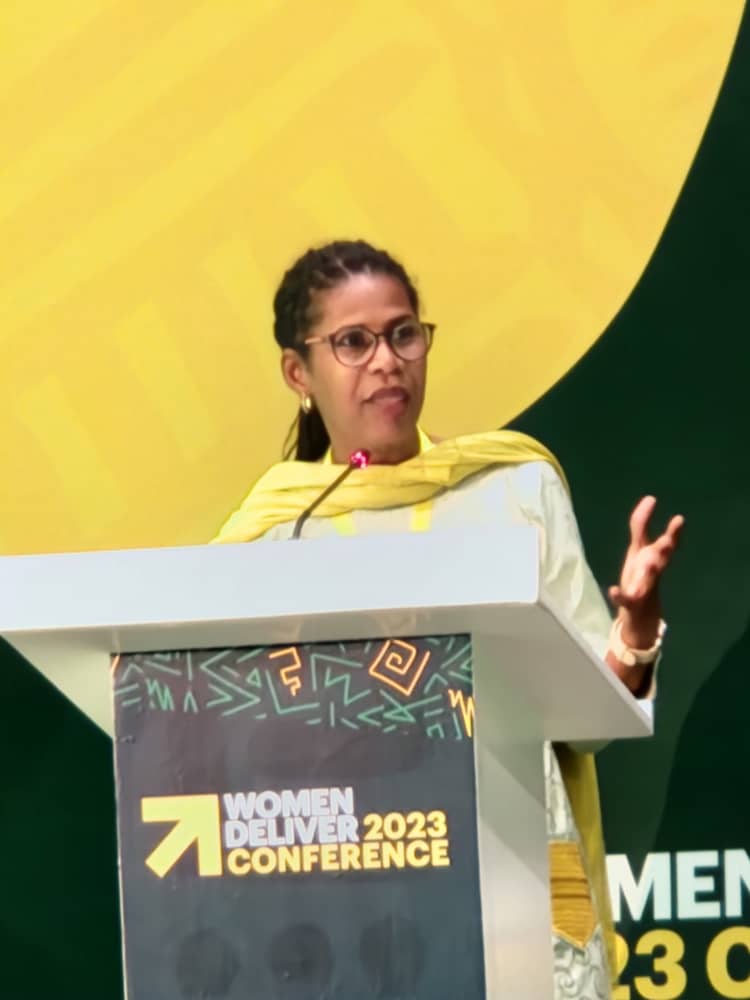
The Women Deliver Conference (WD2023) is one of the largest multi-sector gatherings aimed at advancing gender equality. Co-created Read more
 FR
FR  EN
EN