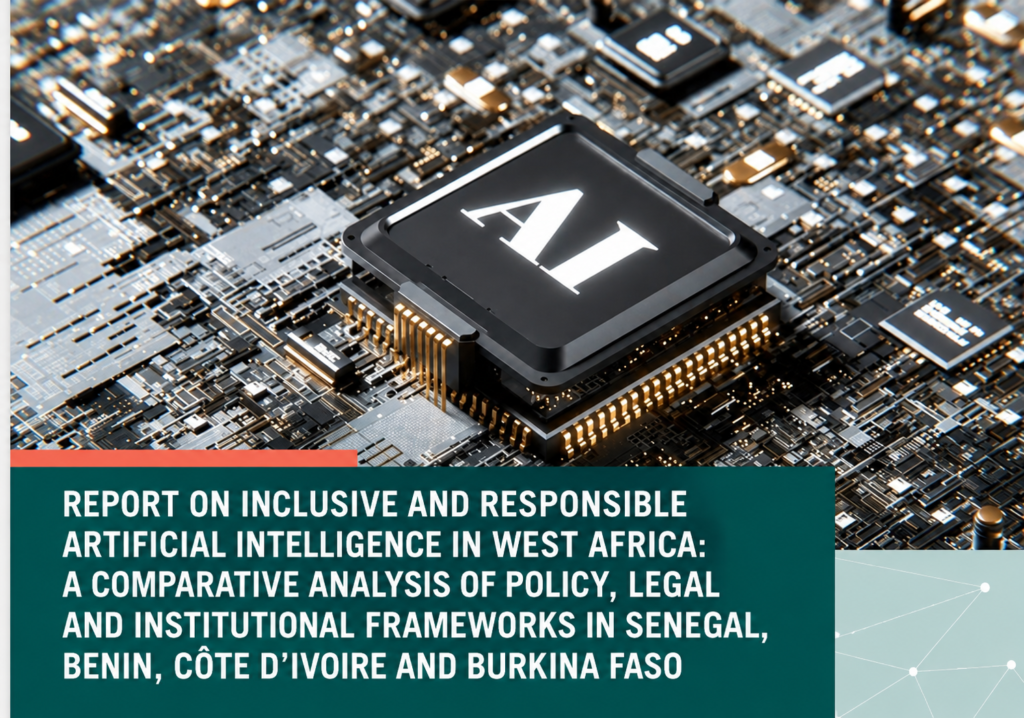
Artificial intelligence (AI) presents a major opportunity to accelerate economic and social transformation in West Africa. However, its development also raises significant issues regarding data protection, equity, non-discrimination, diversity, inclusion and digital sovereignty.
As part of Phase 2 of the Gender and Responsible AI Network (GRAIN), a comparative study analyses the political, legal and institutional frameworks governing artificial intelligence in Senegal, Benin, Côte d’Ivoire and Burkina Faso, with a particular focus on gender, Equality, Diversity and Inclusion (GEDI).
A comparative analysis of national frameworks
The study examines national AI strategies, existing data and cybersecurity legislation, and the institutional frameworks in place. It also places these frameworks in the context of key international and African guidelines, notably the recommendations of UNESCO and the OECD, as well as the African Union’s continental strategy on AI.
The findings show that three of the four countries studied now have a national AI strategy: Senegal, Benin and Côte d’Ivoire. Burkina Faso, however, has not yet adopted an AI strategy, although work is currently underway.
From a legal perspective, all four countries have frameworks in place relating to personal data protection and cybersecurity. However, none of them yet has specific, comprehensive legislation dedicated to artificial intelligence. Burkina Faso stands out, however, for having legislation that explicitly refers to AI-based processing.
GEDI: an aspect that has not yet been sufficiently integrated
One of the key findings of the study concerns the incorporation of Gender, Equality, Diversity and Inclusion (GEDI) into national AI policies.
Whilst Côte d’Ivoire has the most advanced level of GEDI integration amongst the four countries studied, the dimensions of gender and inclusion remain, on the whole, insufficiently operationalised. In particular, the study highlights the absence of monitoring indicators relating to gender and inclusion, gender-responsive budgeting mechanisms and quantified targets concerning women’s participation in governance and AI ecosystems.
This situation is particularly significant given that women remain under-represented in science and technology fields. According to the data cited in the study, they account for 35 % of STEM graduates and 26 % of the workforce in AI and data science in sub-Saharan Africa.
Issues that go beyond regulation alone
The study also highlights several structural challenges: a lack of local and linguistic data, the digital divide, a skills shortage, dependence on foreign technologies, and the risk of algorithmic bias. These issues are particularly significant for African languages, which remain largely under-represented in AI models.
Agriculture, education and African languages, however, appear to be sectors offering significant opportunities for developing AI solutions tailored to local conditions. In particular, the study highlights the potential of precision farming, personalised learning, speech recognition and translation into local languages.
Towards a more inclusive approach to AI governance
Based on these findings, the report sets out several recommendations: to revise national AI strategies to explicitly incorporate GEDI principles; to strengthen institutional governance; to develop legal frameworks specific to AI; to establish mechanisms for transparency and algorithmic auditing; and to build the capacity of stakeholders.
Sector-specific recommendations are also put forward for agriculture, education and local languages, particularly with regard to disaggregated data, equitable access to technology, training and the development of African language databases.
Finally, the report sets out operational guidelines for public decision-makers, innovators, start-ups, regulators and civil society organisations. These focus in particular on integrating GEDI from the design stage of solutions, algorithmic transparency, data quality and representativeness, inclusive funding and regional cooperation.
A call to develop AI tailored to African realities
This study shows that West Africa already has a number of political, legal and institutional foundations in place to support the development of artificial intelligence. The challenge now is to transform these foundations into frameworks that are truly inclusive, operational and tailored to the realities of African societies.
For GRAIN, responsible artificial intelligence cannot be separated from issues of gender, equality, diversity, inclusion, data sovereignty and linguistic diversity.
The aim is to make AI not only a driver of innovation and development, but also a tool capable of reducing inequalities and meeting the needs of all West African populations.
View and download the full report in English and French: Inclusive and responsible artificial intelligence in West Africa: a comparative analysis of the political, legal and institutional frameworks in Senegal, Benin, Côte d’Ivoire and Burkina Faso.
English Version
FRENCH VERSION

On Monday 15 May 2023, IPAR took part in an "expert panel on artificial intelligence as a driver of development” in Saly Read more
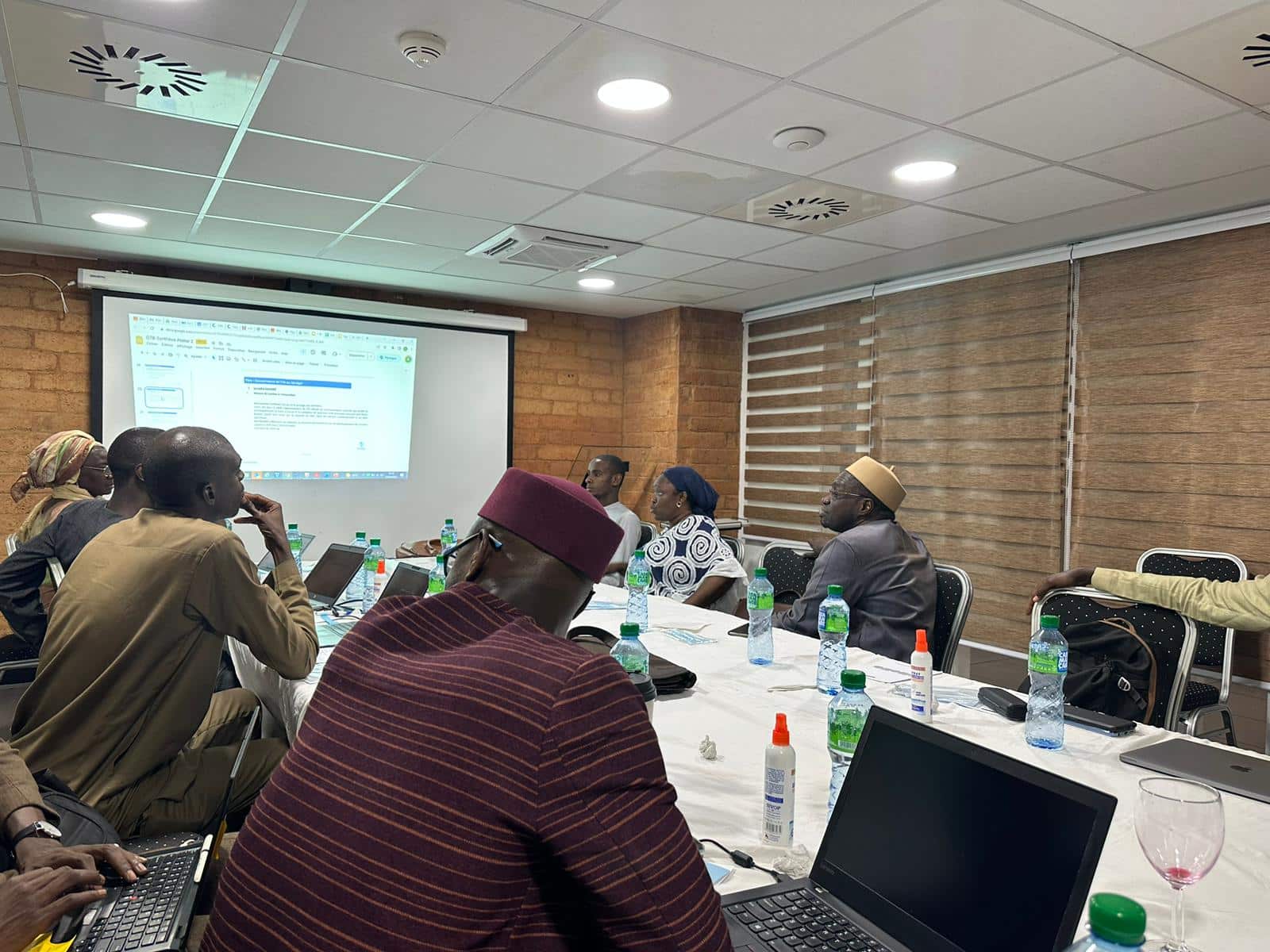
IPAR took part in the second workshop on the formulation of the national Artificial Intelligence strategy, which was held on 21 Read more
 FR
FR  EN
EN