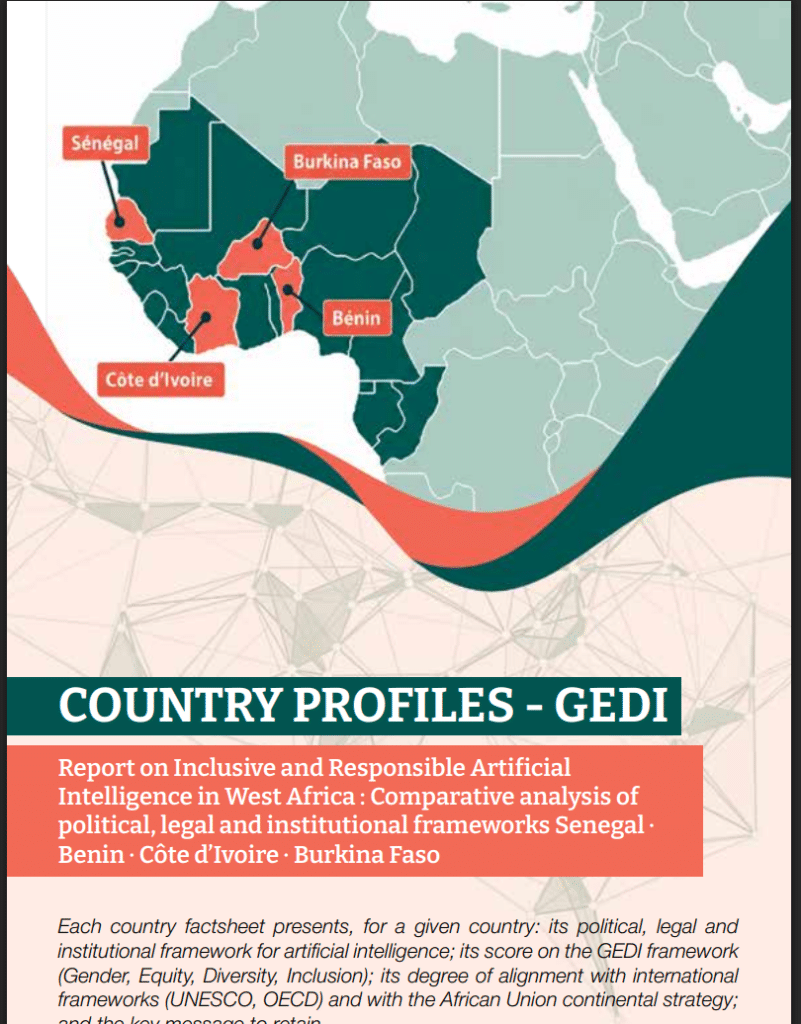
As part of Phase 2 of the GRAIN project, the GRAIN Network is publishing a series of four country briefs on inclusive and responsible artificial intelligence (AI) in Senegal, Benin, Côte d’Ivoire and Burkina Faso.
These factsheets are taken from the report entitled «Inclusive and Responsible Artificial Intelligence in West Africa: A Comparative Analysis of Political, Legal and Institutional Frameworks in Senegal, Benin, Côte d’Ivoire and Burkina Faso».
The report analyses the AI governance frameworks in the four countries, with a particular focus on the integration of the principles of Gender, Equality, Diversity and Inclusion (GEDI).
Progress has been made, but challenges remain
The analysis highlights varying levels of progress. Whilst three of the four countries have relatively well-structured national AI strategies, their implementation and their ability to incorporate inclusionary considerations remain uneven. Burkina Faso, meanwhile, does not yet have a national strategy dedicated to AI.
Looking beyond national differences, several common challenges have been identified: the GEDI principles are still only taken into account to a limited extent in AI policies; specific legal and ethical frameworks remain inadequate; and institutional and technical capacities need to be strengthened.
The report also highlights the low representation of women and under-represented groups in AI governance bodies.
Opportunities for a more inclusive AI
However, the study identifies several sectors in which AI could contribute to more inclusive growth, notably agriculture, education and technologies relating to local languages.
To ensure that these opportunities benefit all sections of the population, the report recommends, amongst other things, strengthening strategic and regulatory frameworks, improving data governance, preventing algorithmic bias and investing more in skills development, particularly for the benefit of women and marginalised groups.
Explore the country profiles
The four factsheets provide a summary of the report’s key findings for each country. In particular, they outline the political, legal and institutional framework for AI, the extent to which GEDI principles have been incorporated, alignment with international standards, and the key takeaways.
See the English version of the country fact sheets
View the French version of the country fact sheets
Not so long ago, people lived and went about their daily lives in close-knit communities. Every shopkeeper knew their customers personally and could...
This Machine Learning Glossary aims to provide a brief introduction to the most important machine learning terms – both for commercial and...
 FR
FR  EN
EN