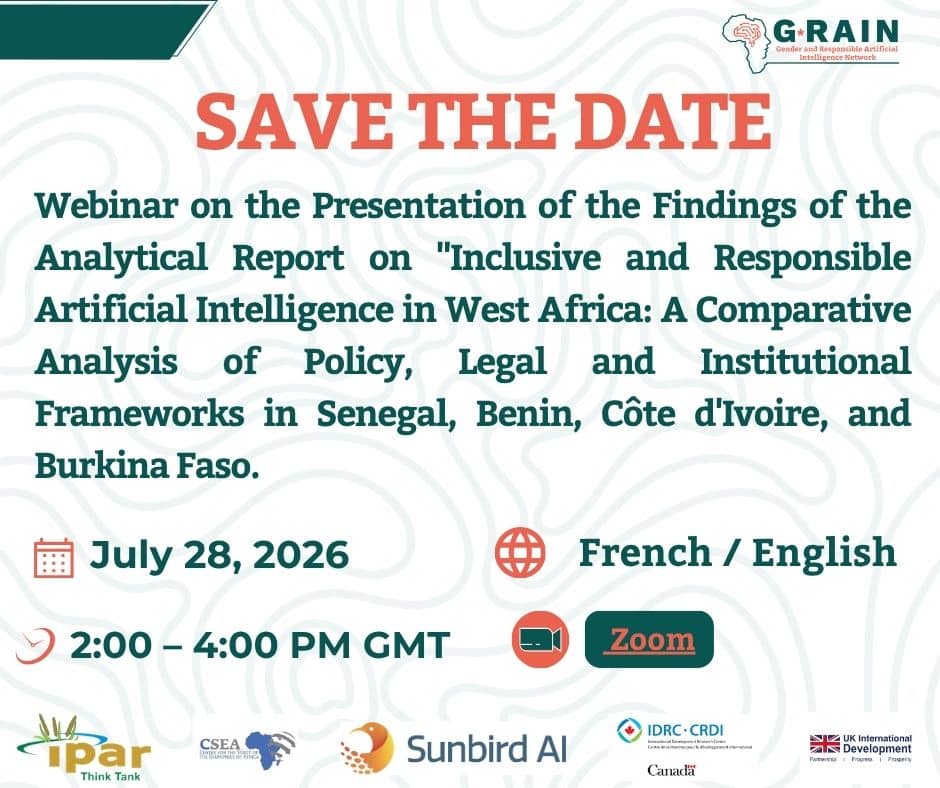
As part of its ongoing activities, the Gender and Responsible AI Network (GRAIN) is organizing a webinar to present the findings of its regional analytical report entitled: “Inclusive and Responsible Artificial Intelligence in West Africa: A Comparative Analysis of Policy, Legal and Institutional Frameworks in Senegal, Benin, Côte d’Ivoire and Burkina Faso.”
The webinar will bring together researchers, policymakers, artificial intelligence experts, civil society representatives, technical and financial partners, and members of the GRAIN Network to engage in a dialogue on the progress achieved, the persistent challenges, and the opportunities for strengthening responsible AI public policies across West Africa.
Conducted across four countries in the sub-region, the study highlights significant progress in the development of national AI strategies, legal frameworks, and institutional mechanisms governing artificial intelligence. It also identifies remaining gaps in governance, ethics, inclusion, data protection, and regional coordination.
Leading Experts to Enrich the Discussion
To examine the findings of this comparative study and discuss the future of AI governance in West Africa, the GRAIN Network will convene a panel of distinguished experts from the fields of research, public policy, data science, law, and advocacy.
The webinar will be moderated by Dr. Marame Cissé Sow, Sociologist and Thematic Coordinator for Youth, Women and Entrepreneurial and Mobility Strategies at the IPAR Think Tank.
The report’s key findings will be presented by Fatou Fofana, Legal Counsel and Head of the Legal Department at the Senegalese Institute of Agricultural Research (ISRA). An expert in business law, intellectual property, and AI governance, she has played a central role in GRAIN’s research on AI policy, legal, and institutional frameworks in West Africa and has contributed to the development of recommendations aimed at promoting responsible and inclusive AI governance.
The discussion panel will also feature Laetitia Badolo, Director of Advocacy and Impact at Niyel. With extensive experience in designing advocacy strategies and facilitating dialogue among public institutions, civil society, and development partners, she works on a wide range of issues, including artificial intelligence, governance, agriculture, climate, health, and education.
She will be joined by Cheikh Faye, Head of Data at IPAR, who will contribute his expertise in statistics, data analysis, and business intelligence.
The discussion will also benefit from the participation of Mamadou Mbodji, Senior Data Scientist at World Data Lab. A statistician and data science specialist, he leads international initiatives focusing on data infrastructure and youth employment policies across Africa.
The webinar will take place on Tuesday, 28 July 2026, from 2:00 p.m. to 4:00 p.m. GMT, and will be held virtually via Zoom. The event will be conducted in both French and English, with simultaneous interpretation to ensure the full participation of both Francophone and Anglophone stakeholders across the region.
Through this webinar, the GRAIN Network aims to share the key findings of this comparative analysis, encourage dialogue among stakeholders within the AI ecosystem, and contribute to ongoing discussions on developing public policies that promote inclusive, responsible, and gender-responsive artificial intelligence.
Registration link :https://us06web.zoom.us/webinar/register/WN_NSk3ANbtSb-SKTYs7D-byA

L’IPAR a participé, lundi 15 mai 2023 à Saly, à un "panel d’experts sur l'intelligence artificielle comme levier de développement Read more
IPAR poursuit la mise en œuvre du projet DUA dans les pays pilotes. Après le Sénégal, le Burkina (CEDRES) et Read more
 FR
FR  EN
EN