As African countries continue to invest in digital transformation and digital skills development, a new publication from the Gender and Responsible Artificial Intelligence Network (GRAIN) challenges a widely held assumption: that stronger digital literacy automatically protects women from online violence.
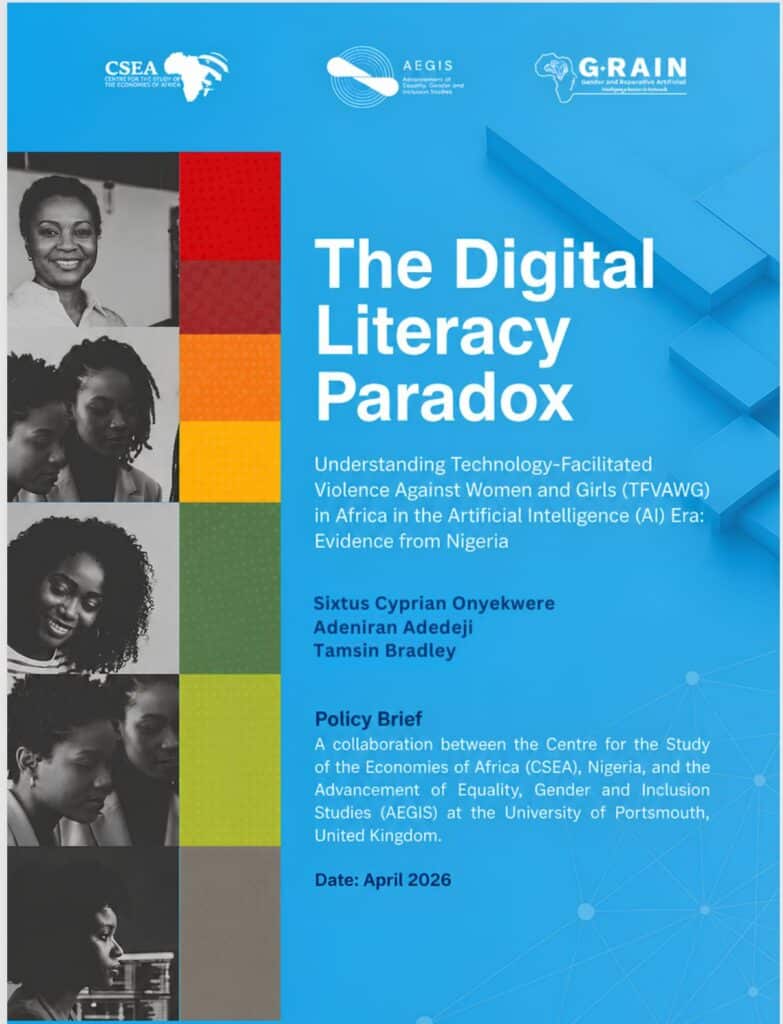
Published in April 2026 under the title The Digital Literacy Paradox: Understanding Technology-Facilitated Violence Against Women and Girls (TFVAWG) in Africa in the Artificial Intelligence Era: Evidence from Nigeria, this Policy Brief presents the findings of a study conducted in Nigeria by the Centre for the Study of the Economies of Africa (CSEA) in collaboration with AEGIS – Advancement of Equality, Gender and Inclusion Studies at the University of Portsmouth, United Kingdom, as part of the GRAIN Project.
Rethinking Digital Safety Policies
Across Africa, many digital inclusion initiatives are built on the belief that equipping women with digital skills will reduce their vulnerability to online harm. Governments, development partners, and civil society organizations have therefore invested heavily in digital literacy and capacity-building programmes.
However, the findings of this study tell a different story.
By examining the experiences of women internet users in Nigeria, researchers found that higher digital literacy consistently appears in the pathways leading to technology-facilitated violence against women and girls (TFVAWG). In other words, women who are digitally skilled, younger, and highly active online are often among those most exposed to online abuse and harassment.
This finding highlights what the authors describe as the “Digital Literacy Paradox”: while digital technologies create new opportunities for education, employment, entrepreneurship, and civic participation, they also increase women’s exposure to online violence.
Artificial Intelligence Is Changing the Nature of Online Violence
The study further demonstrates how the rapid advancement of generative artificial intelligence is transforming online gender-based violence.
Emerging technologies now make it easier to create deepfake images, generate non-consensual intimate content, coordinate large-scale harassment campaigns, and deploy AI-powered tools that amplify abuse. These new forms of violence extend existing gender inequalities into digital spaces and reinforce long-standing patterns of discrimination and violence against women and girls.
The authors emphasize that Technology-Facilitated Violence Against Women and Girls (TFVAWG) should not be viewed as a separate digital issue but rather as a continuation of offline gender-based violence enabled by new technologies.
Key Findings
The survey reveals the alarming scale of online violence experienced by women in Nigeria.
Among the respondents:
63.9% experienced at least one form of online violence during the previous 12 months.
79% reported suffering emotional distress after the incidents.
44% said the violence negatively affected their education, work, or income.
Despite the significant impact, only 1% reported the incidents to the police.
These findings demonstrate that online violence has far-reaching consequences beyond the digital sphere, affecting women’s mental health, economic opportunities, and participation in public life.
Beyond Digital Skills: Building Safer Digital Spaces
One of the report’s strongest messages is that improving digital literacy alone is not enough.
The authors argue that digital safety policies must move beyond individual capacity building and focus on broader structural solutions. They recommend strengthening victim protection mechanisms, improving reporting systems, enforcing existing legal frameworks, increasing platform accountability, and developing policies that address emerging AI-enabled risks.
As women’s participation in digital spaces continues to grow, so too must the systems designed to protect them.
Advancing Responsible AI in Africa
This publication reflects GRAIN’s commitment to generating evidence that supports the development of inclusive, ethical, and responsible artificial intelligence across Africa.
By examining the intersection of gender, artificial intelligence, digital inclusion, and online safety, the Policy Brief provides valuable evidence for policymakers, researchers, civil society organizations, technology companies, and development partners working to build safer digital ecosystems.
Ultimately, the study reminds us that digital transformation cannot be truly inclusive if women and girls remain vulnerable to technology-facilitated violence. Ensuring safer digital environments must therefore become a central pillar of responsible AI governance and digital development across the continent.
Read the Policy Brief below

L’IPAR a participé, lundi 15 mai 2023 à Saly, à un "panel d’experts sur l'intelligence artificielle comme levier de développement Read more
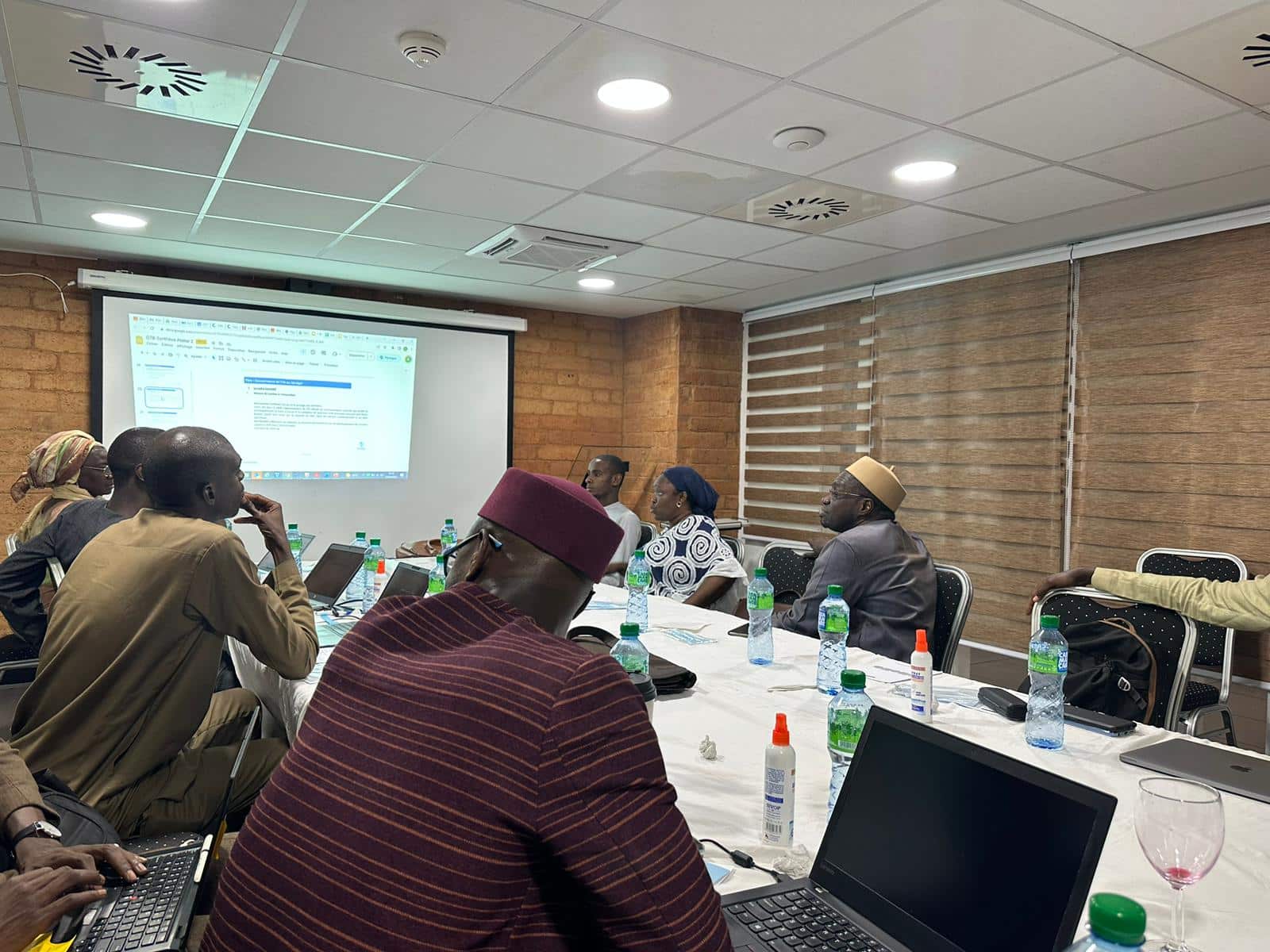
IPAR a participé au deuxième atelier de formulation de la stratégie nationale de l’Intelligence Artificielle qui s’est tenu les 21 Read more
 FR
FR  EN
EN