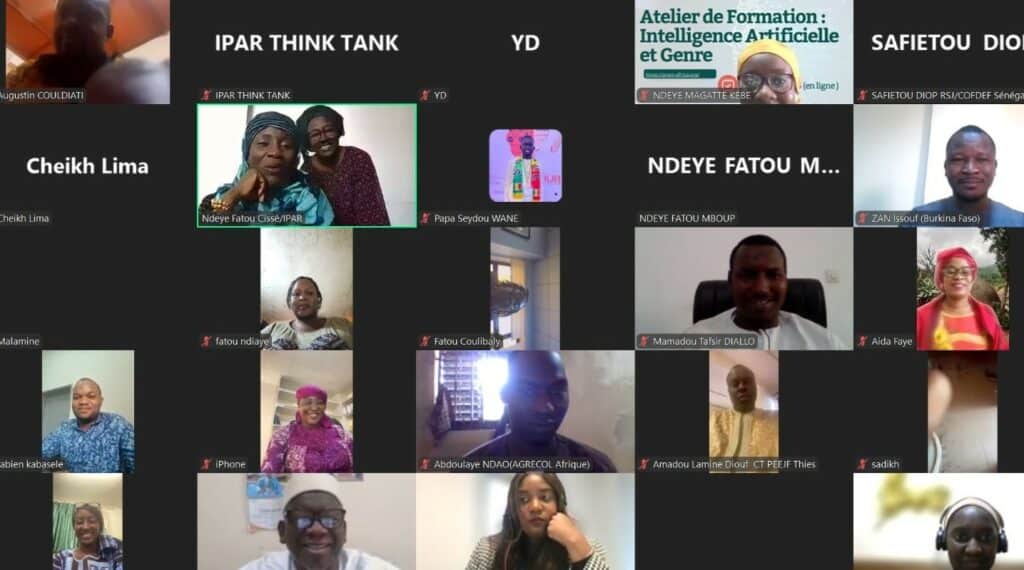
On Friday 21 February 2025, around a hundred participants took part in the online training session on Artificial Intelligence and Gender organised by the GRAIN network (Gender and Responsible Artificial Intelligence Network).
Indeed, as part of the Grain project – and particularly through the coordination of its network – face-to-face and online training courses are offered with the aim of raising awareness and equipping a wide audience with the best practices to adopt in the fields of gender and artificial intelligence.
Led by Ndeye Fatou Cissé, a gender expert at Ipar, the training session aimed to deepen participants’ understanding of gender mainstreaming in AI-related projects.
Following the introduction and presentation of the objectives by Ndeye Fatou Mboup, an expert in Artificial Intelligence and coordinator of the Grain project, Ms Cissé, head of training, led a presentation on the topic: “Gender, artificial intelligence and inclusion: laying the foundations for a responsible and equitable ecosystem”.
In her presentation, she discussed the deconstruction of gender stereotypes, the promotion of best practices for more inclusive AI, and improving understanding of a number of gender-related concepts, such as sexist stereotypes, gender equality, social inclusion and intersectionality, amongst others.
To ensure gender is properly integrated into AI, she proposed the concept of «gender mainstreaming», which is an integrated approach to incorporating the gender dimension at every stage of public policy, as well as the use of AI to reduce disparities in education, health, employment and access to technology.
In short, her speech promotes a more equitable AI by incorporating a gender perspective, with a view to combating discrimination and fostering an inclusive society.
As part of a participatory and collaborative approach, the various groups undertook practical work aimed at identifying and correcting gender bias in AI solutions. In short, the aim was to propose solutions for more inclusive employment policies in Senegal; to increase the number of women in AI-related professions; to use AI to combat gender-based violence; and to assess the impact of public policies on women.
The various findings that emerged from these group discussions have helped to identify solutions that highlight the importance of technological innovation; inclusive policies; awareness-raising and regulation to combat discrimination and promote equality in employment, and protection against gender-based violence; women’s participation in decision-making bodies; the need to increase the presence of women at all stages of artificial intelligence development, particularly in design, coding, programming, development, management and evaluation; training for women and young people to ensure the optimal use of AI; and the reduction of discrimination and data analysis, amongst other things.
Among the recommendations arising from this training session, the following are worth noting: the role of artificial intelligence in tackling gender disparities in sectors such as education, health, employment and access to technology, as well as the role of AI in assessing the impact of public policies on women.
Not so long ago, people lived and went about their daily lives in close-knit communities. Every shopkeeper knew their customers personally and could...
This Machine Learning Glossary aims to provide a brief introduction to the most important machine learning terms – both for commercial and...
 FR
FR  EN
EN