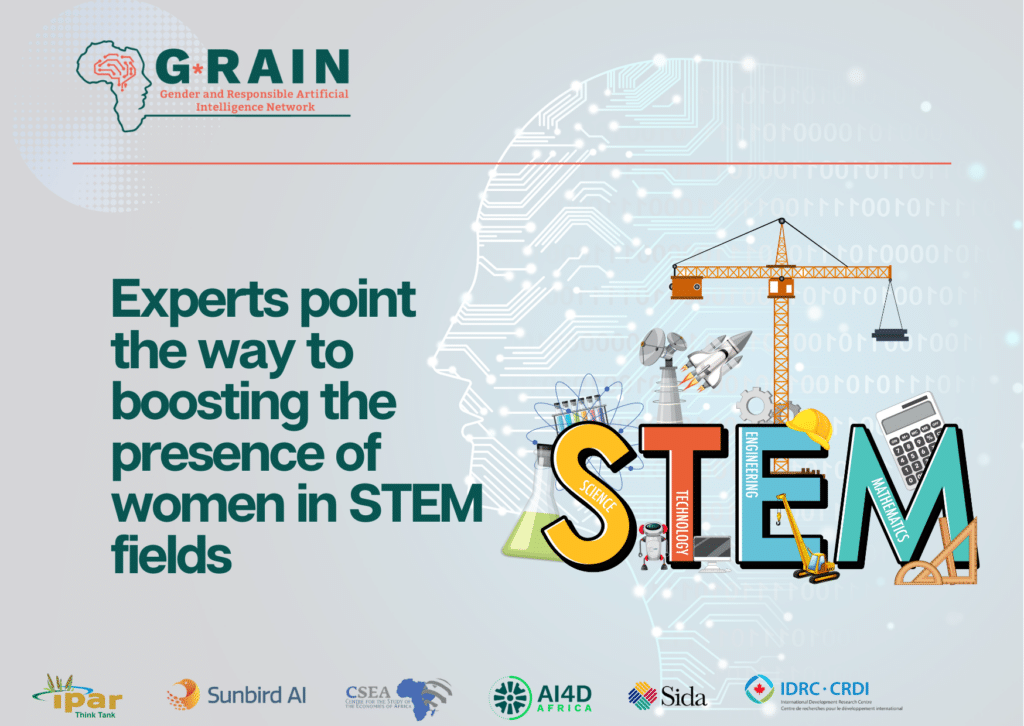
In an ever-changing world, STEM subjects (Science, Technology, Engineering and Mathematics) play a crucial role in technological development and innovation. Unfortunately, women remain under-represented in these fields.
In a virtual debate organised by the GRAIN Network (Gender and Responsible Artificial Intelligence Network), the female experts invited to take part in the discussion shared the challenges that need to be overcome, as well as recommendations to help highlight women’s achievements in STEM, with a view to inspiring more young women to pursue careers in these fields.
The debate featured Ms Maimouna Leye Diakhaté, President of SENUM (Synergie pour l’Éducation au Numérique et aux Médias) in Senegal; Dr Juliet Moso, Senior Lecturer at Dedan Kimathi University of Technology in Kenya; and Marwa Cheikh-Youssef, President of HACK&PITCH in Morocco.
Moderated by Dr Ndeye Fatou CISSE, a gender expert at the IPAR Think Tank and a member of the GRAIN project consortium, the experts discussed the challenges hindering the advancement of women in STEM. These obstacles are often linked, amongst other things, to the low representation and lack of opportunities for girls in science and technology at grassroots level, gender stereotypes, a lack of infrastructure and funding, the low representation of women in science-related jobs, poverty in rural areas, socio-cultural constraints that prevent girls from progressing to higher levels of education, the failure to adapt programmes and training for rural women, and the inadequacy of policies aimed at the inclusion of girls,
However, according to Maïmouna Leye Diakhaté, President of SENUM (Synergy for Digital and Media Education in Senegal), “STEM is often perceived as a field intended exclusively for educated women in the science streams, whereas there are many uneducated women or women in the arts streams who have successfully transitioned into STEM careers.”.
Ms Diakhaté, a digital expert, shared the example of her career path as a literary scholar who has now moved into the STEM field.
Morocco’s Marwa Cheikh-Youssef, for her part, runs short, intensive programmes for women, tailoring the training to their daily lives, their level of education and their social circumstances.
Dr Juliet Moso, a senior lecturer at Dedan Kimathi University of Technology, takes a grassroots approach, introducing children to technology in a supervised manner to counter gender bias and stereotypes.
Furthermore, she believes that teachers and parents need to be introduced to and made aware of STEM so that they understand its benefits.
Recommendations
The debate highlighted a range of recommendations aimed at increasing the number of women in scientific fields, particularly technology.
The experts proposed, amongst other things, a reduction in gender inequalities in access to the labour market to better address the challenges faced by women in STEM professions; the implementation of inclusion strategies and the adaptation of STEM programmes to women’s gender realities; the adoption of a policy capable of ensuring gender balance between boys and girls to ensure the equitable participation of men and women in STEM professions; challenging the perception that STEM is only for science students; and the adoption of more inclusive outreach strategies in advocacy and promotion programmes for girls in STEM fields, so as to attract women with a humanities background or a high level of education.
For these specialists, it is essential to raise awareness from an early age, to promote role models through conferences, mentoring, funding and support structures such as scholarships, and also to combat gender stereotypes.
Not so long ago, people lived and went about their daily lives in close-knit communities. Every shopkeeper knew their customers personally and could...
This Machine Learning Glossary aims to provide a brief introduction to the most important machine learning terms – both for commercial and...
 FR
FR  EN
EN