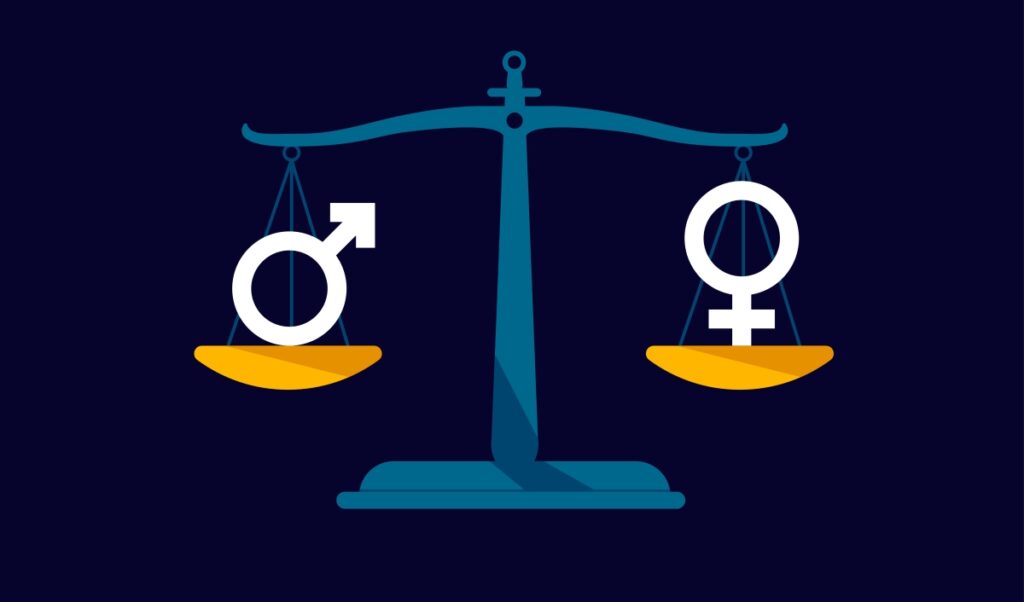
At VivaTech 2025, BDM attended a conference led by Leïla Grison, Chief Executive of the Women’s Forum for the Economy and Society. It was an opportunity to discuss a crucial issue: the inequalities in access to AI between men and women, as well as ways to reduce them.
AI: when humanity falls back into its old ways
As we know, AI is set to have a significant impact on many careers in the tech and digital sectors. Yet a pattern is emerging. Just as many young girls have come to believe that maths is not for them, leaving STEM (careers in science, technology, engineering and mathematics) to men, history seems to be repeating itself in the field of artificial intelligence. Indeed, at present, 88 % of AI algorithms are developed by men (source: The Future is Fem[AI]le report). Other key figures to note: whilst 73 % of executives believe it is important to have more women in AI-related roles, only 33 % of them currently have a woman leading strategic decision-making on this issue.
Consequently, algorithmic models – developed mainly by male-dominated teams – generate biased data, thereby further reinforcing existing inequalities. This imbalance raises questions at a time when AI is set to play a major role in the transformation of our societies.
“It is essential to look to the future and understand where women fit into AI, as this technology is set to radically transform jobs, skills and decision-making,” explains Leïla Grison.
Does technology hinder women’s employability?
At first glance, the rise of AI may be seen as a barrier to women’s employability. Leïla Grison highlights three key points:
The massive creation of new jobs in AI: with new opportunities that would be out of reach for women, as they are under-represented in STEM subjects and in major tech companies. «We don’t want there to be fewer men in tech and engineering roles; we just want there to be more women,» explains Leïla Grison.
The restructuring of sectors with high potential for automation: sectors in which women are, unfortunately, over-represented.
The increase in productivity among those who use AI – and therefore among those who have the opportunity to train in this field – and, conversely, the marginalisation of those – and especially women – who are unable to access it.
Ultimately, artificial intelligence is not going to replace women’s jobs, but rather the jobs of those who do not get to grips with AI. That is why it is so important for women to get to grips with the subject!
What if AI could help speed up the reduction of inequalities?
«Today, we all have the power at our fingertips to help advance women’s careers and knowledge by feeding data into AI, and to create a more inclusive technology,» explains Leïla Grison. Here are a few examples of the tangible benefits that AI offers women:
New job opportunities: by reinventing existing roles and creating new ones, AI can help women fast-track their careers (career changes, diversification, etc.).
Support with the «double burden»: AI can provide valuable support in tackling the challenges associated with the «double burden» faced by many women, by making it easier for them to balance their careers with their parenting and domestic responsibilities.
A way to break through the glass ceiling: by providing opportunities for training and skills development through AI.
A means of reducing economic inequality: ultimately, AI offers women access to new resources and opportunities.
However, certain conditions must be met in order to reduce these inequalities. It is therefore essential to continue striving for universal access: «AI must not be reserved for a privileged few, at the risk of exacerbating existing inequalities,» explains Leïla Grison. It is also important to make it clear that delegating tasks to AI is not the same as cheating.
If we don’t change the way we view AI, we will be denying our children access to this technology. And denying them access to AI because we think using it is cheating is to cut them off from success in a world where, in the future, mastering AI will be more important than technical skills when it comes to getting a job.
Written by: Appoline Reisacher
https://www.blogdumoderateur.com/auteur/appoline-reisacher
Source: https://www.blogdumoderateur.com/femmes-ia-retard-combler-construire-tech-inclusive/
Not so long ago, people lived and went about their daily lives in close-knit communities. Every shopkeeper knew their customers personally and could...
This Machine Learning Glossary aims to provide a brief introduction to the most important machine learning terms – both for commercial and...
 FR
FR  EN
EN